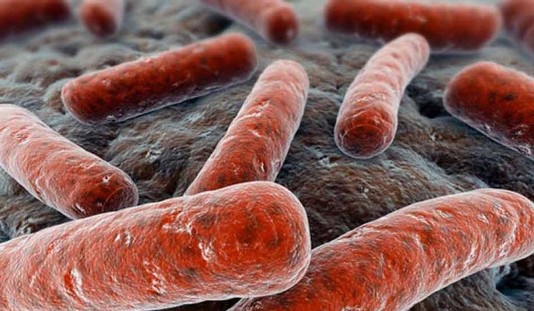
Tuberculosis (TB) is a complex disease involving humans, domestic animals, wildlife, and the environment. Its burden is particularly severe in developing countries, where it has major public health and socioeconomic consequences. Because of its persistent global spread and re-emergence, some authors describe tuberculosis as a new pandemic.
Systems Thinking provides a powerful framework to understand, test, and continuously update our mental models of complex phenomena such as tuberculosis. Rather than analyzing isolated components, this approach focuses on interactions, feedback loops, and dynamic behavior within the whole system. To better understand the complexity of tuberculosis, causal loop diagrams were developed to represent the relationships among key variables.
Figure 1 presents the causal loop diagram describing tuberculosis in domestic animals (particularly bovine populations), wildlife, and the environment. Blue arrows indicate direct (positive) proportional relationships, while red arrows indicate inverse (negative) proportional relationships. Reinforcing loops (R) describe mechanisms that amplify the spread and persistence of tuberculosis, whereas balancing loops (B) represent mechanisms that counteract disease diffusion. Several leverage points are identified in this system, including biosecurity efforts, sanitary inspections, and environmental decontamination. Strengthening these interventions can significantly reduce the prevalence and transmission of tuberculosis in animal populations.
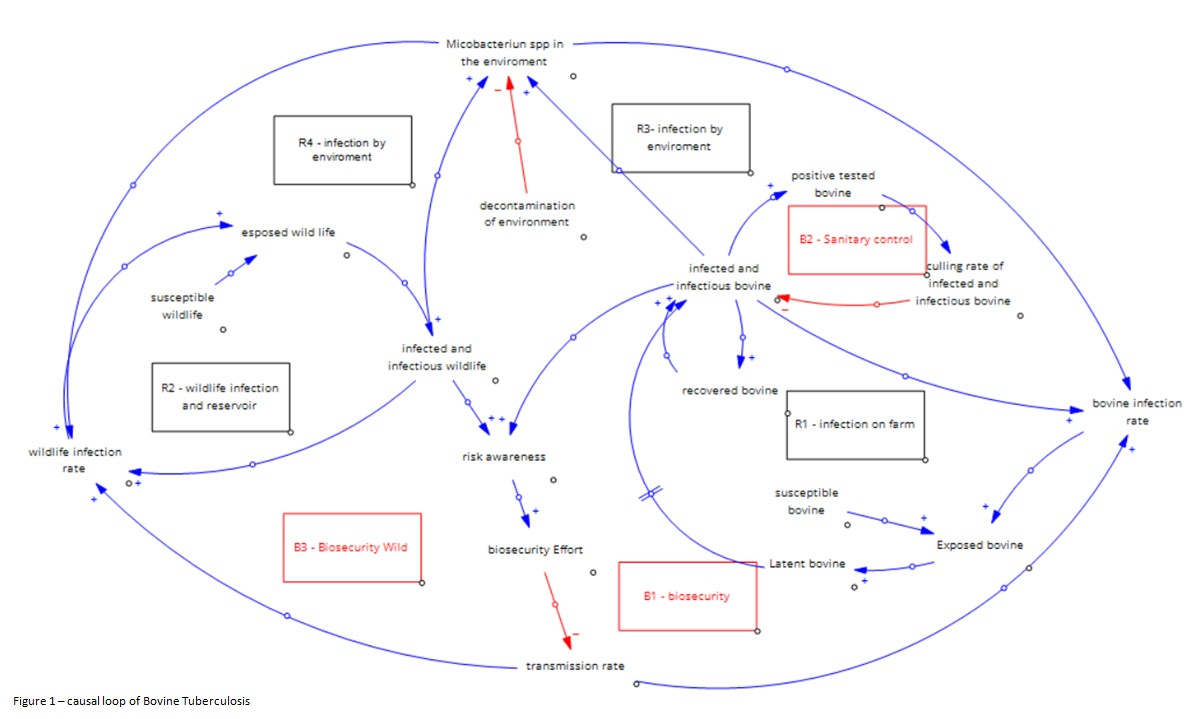
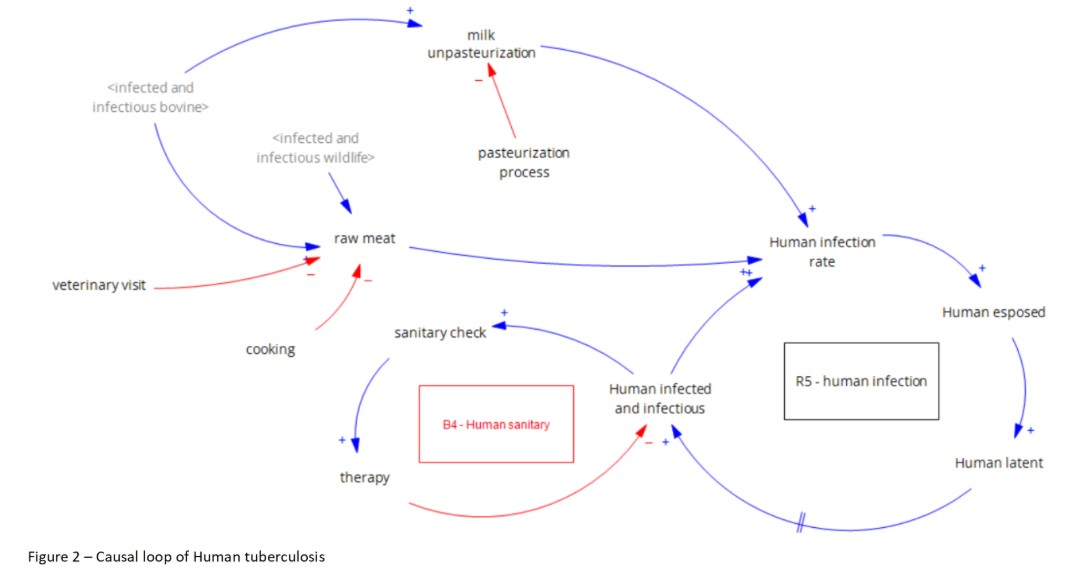
Figure 2, as in the previous figure, blue arrows represent direct proportional relationships and red arrows represent inverse relationships. Reinforcing loops explain how tuberculosis can escalate within human populations, while balancing loops highlight control mechanisms. Key leverage points in the human system include effective therapy, regular veterinary inspections (to control zoonotic transmission), and milk pasteurization. These interventions reduce human exposure to tuberculosis and interrupt transmission pathways, particularly those linked to animal reservoirs.
The proposed causal loop models help define the underlying system governing tuberculosis across humans, animals, and the environment. By identifying reinforcing and balancing feedback loops, this systems-based approach highlights critical leverage points for intervention. Further refinement and quantitative analysis of these models could improve system understanding and support more effective strategies for tuberculosis prevention and control.
(*) Puede solicitar información más detallada de este trabajo al autor
|