4.23. A STUDY OF THE OSCILATORY MOVEMENTS
A simulation model with Vensim
 The study of oscillatory movements has always been motive for conflict, especially for students. What is this conflict? From the mechanical courses to the study of oscillators, we see systems whose complexity is given in cases with constant acceleration. From here, the said cinematic variable also changes its value depending on the time which can be disconcerting for students. This uncertainty increases when the students solve the differential equations to find the cinematic variables (position, speed and acceleration) and/or the dynamic variables (quantity of movement and strength), and they lose the capacity to analyse the behaviour of the variables that have an influence - or not- in the movements.
To try to solve this situation, an alternative study of the different Oscillators is proposed using System Dynamics as a tool.
The Forced Oscillatory Movement
We will study the oscillatory movement in a dimension that describes a system formed by a pendulum, a body of mass m, suspended from the extreme of an ideal spring with an elastic constant k-, when this is perturbed -elongating or compressing- respect its position of balance x0, a distance x.
The model of the forced oscillatory movement is presented below:
This model has 4 levels:
The study of oscillatory movements has always been motive for conflict, especially for students. What is this conflict? From the mechanical courses to the study of oscillators, we see systems whose complexity is given in cases with constant acceleration. From here, the said cinematic variable also changes its value depending on the time which can be disconcerting for students. This uncertainty increases when the students solve the differential equations to find the cinematic variables (position, speed and acceleration) and/or the dynamic variables (quantity of movement and strength), and they lose the capacity to analyse the behaviour of the variables that have an influence - or not- in the movements.
To try to solve this situation, an alternative study of the different Oscillators is proposed using System Dynamics as a tool.
The Forced Oscillatory Movement
We will study the oscillatory movement in a dimension that describes a system formed by a pendulum, a body of mass m, suspended from the extreme of an ideal spring with an elastic constant k-, when this is perturbed -elongating or compressing- respect its position of balance x0, a distance x.
The model of the forced oscillatory movement is presented below:
This model has 4 levels:
a) the quantity of movement px, that is modified by the flux dpx/dt (the strength in x)
the position x that is modified by the flux dx/dt (the velocity in x);
the velocity vx, affected by the flux dvx/dt (the acceleration in x);
the mass m, affected by the flux dm/dt (in this model the mass doesn't vary in time).
The acceleration is influenced by the following auxiliary variables:
the constant elastic of the spring k;
the mass m
the difference or Gap between the position x (level) and the position of balance x0
the constant of deadening b;
the strength F;
the phase o, what is the same as the product of the frequency w and the time t.
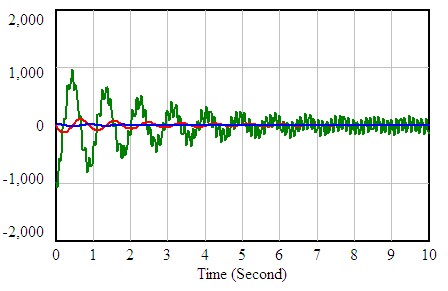
The model can be used to analyse the cinematic variables (position, velocity and acceleration) or dynamics (quantity of movement and strength).
Although the variables can be analysed in an individual form, the can be grouped together in two visual representations: one that involves the cinematic variable, and another for quantity of movement and strength.
We can obtain the following conclusions from the model created:
when the mass increases, the period of deadened oscillatory movement increases;
when the constant k increases, the period of deadened movement decreases.
As a consequence, a direct relation between the period of oscillation and the mass of the pendulum, and an inverse relation between said period and the elastic constant of the spring exists.
The mathematical expression of the period depending on the mass and the elastic constant of the spring, can be found using processing of the numerical data of the simulation, or using differential equations that are the result of the application of the second law of Newton.
This study attempts to highlight the great educative advantages of using System Dynamics in analysis of Forced Oscillatory Movements both deadened and harmonic.
Employing the same model and modifying the values of the variables according to the case being studied, graphics are produced that greatly facilitate the comprehension and the discussion of the system analysed.
|
 See the book