4.7. INGESTION OF TOXINS
A simulation model with Vensim
 The human being has recognised the venomous character of certain plants and animals from the first stages of history. Nevertheless, the enormous development of industrial activity, particularly the chemical industry, has caused the creation of a large number of artificial chemical substances, both in the quality of primary materials and in the residues of certain processes. Many of these chemicals have adverse effects on nature and human beings.
The study of these substances and their effects on humans has introduced a relatively new science, toxicology, that in its development has incorporated elements from other sciences such as physiology, pharmacology, biochemistry and epidemiology. What arises from this is that the study of the problematic derivative from the exposition to toxic substances requires the collaboration of various disciplines. Therefore it is interesting to view these problems from the System Dynamics point of view that incorporates the different elements that compose them in a model of analysis and measure that operates systematically and consequently allows us to observe the mutual influences that take place.
When an organism is exposed to a toxic substance, a series of complex processes of absorption, distribution, metabolism and elimination (ADME) take place whose speeds are difficult to calculate.
The simplest outline enables us to imagine an organism receiving a determined quantity of the toxin and the same time eliminating a proportion of the toxin. If the elimination is very rapid, it is probable that the organism can tolerate new quantities in divided doses. However, if the elimination is a slow, exposure during a long period of time can cause an accumulation of the toxin that goes over the limit resulting in anything from allergic reactions to death.
Nevertheless, the danger of a substance is not enough to characterise the risk of intoxication. All the factors which contribute to the organism incorporation of toxins must be considered, such as the exposure scenario, the concentration in the contaminated environment, the channel, the exposure's frequency and duration and the characteristics of the individual.
On the other hand the analysis of risk is also a tool which allows us to implement mitigation measures.
The following model simulates the emission of a gaseous toxin and its inhalation by an individual exposed to the influence. Various aspects of the process are organized in the following way:
1) The emission is toxic from a specific source, calculated in molecules/hour in a given temperature expressed in Kº from an evaporation surface measured in m2. The pressure of the vapour is the substance in consideration, at the temperature in the environment. The system of transference to the environment is characterised by a coefficient of the transference of the mass.
2) The scenario is constituted by the precinct where the source of emission is contained. Its volume allows us to calculate the effective concentration that is expressed in mg/m3 after multiplying the emission in mol/hour by the molecular weight of the substance. This concentration is compared with the permitted limit (in this case the dose of reference for inhalation) and through the relationship between both elements, the rate of air renewal is regulated as a mitigation measure.
3) Finally, the level of toxin accumulated represents the quantity in the organism exposed. In the organism exposed, a quantity known as Incorporation is measured in mg/hour. This is determined by the variable Concentration, the rate of inhalation, the amount of air breathed by a healthy individual every hour, and the effective exposure that allows us to simulate a working week with a set shift pattern, daily breaks and weekends.
The toxin accumulated is lowered by elimination, which responds to a kinetic of the first order. In other words, the quantity accumulated is proportional to the quantity present depending on the Elimination Coefficient. As additional data the Internal Concentration is calculated dividing the toxin accumulated by the body weight.
The model
When a toxic substance enter in a living organisms, an extremely complex series of reactions take place. The process involves absorption, metabolism and elimination mechanisms, the velocity of which is very difficult to calculate.
The simplest scheme is to imagine a known quantity of toxic entering the organism, which is capable to eliminate a part of the entering toxic. If the elimination rate is very high, is probably that the organisms tolerate new ingestions of toxic. On the opposite, the organisms could reach or inclusive exceed the toxicity threshold, undergoing adverse consequences, since alergenic reaction until death.
Consequently, besides the knowledge about the toxic characteristics of a substance is necessary to take into account the duration, concentration and frequency during which the organism is exposed to ingestion.
1) Accumulated Toxic Level simulates the exposed organism.
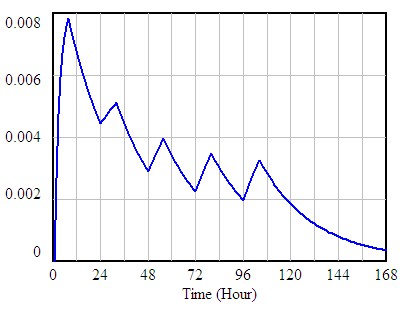
2) The organism incorporates a toxic quantity called Incorporation, in mg/h, which depends on Concentration (environmental toxic concentration) and Exposure Hours (the time in hours during which the organism is exposed to toxic). In addition, Exposure Hours allows the simulation of a work week with certain shift, daily and week-end rest.
3) Some toxic quantity is released by the organism, through Elimination flow, according a first order kinetics. In other words, the eliminated quantity is proportional to accumulated quantity.
This kind of reaction allows an easy estimation of "half time", the time necessary to reach a concentration equal to a half of the initial concentration.
The human being has recognised the venomous character of certain plants and animals from the first stages of history. Nevertheless, the enormous development of industrial activity, particularly the chemical industry, has caused the creation of a large number of artificial chemical substances, both in the quality of primary materials and in the residues of certain processes. Many of these chemicals have adverse effects on nature and human beings.
The study of these substances and their effects on humans has introduced a relatively new science, toxicology, that in its development has incorporated elements from other sciences such as physiology, pharmacology, biochemistry and epidemiology. What arises from this is that the study of the problematic derivative from the exposition to toxic substances requires the collaboration of various disciplines. Therefore it is interesting to view these problems from the System Dynamics point of view that incorporates the different elements that compose them in a model of analysis and measure that operates systematically and consequently allows us to observe the mutual influences that take place.
When an organism is exposed to a toxic substance, a series of complex processes of absorption, distribution, metabolism and elimination (ADME) take place whose speeds are difficult to calculate.
The simplest outline enables us to imagine an organism receiving a determined quantity of the toxin and the same time eliminating a proportion of the toxin. If the elimination is very rapid, it is probable that the organism can tolerate new quantities in divided doses. However, if the elimination is a slow, exposure during a long period of time can cause an accumulation of the toxin that goes over the limit resulting in anything from allergic reactions to death.
Nevertheless, the danger of a substance is not enough to characterise the risk of intoxication. All the factors which contribute to the organism incorporation of toxins must be considered, such as the exposure scenario, the concentration in the contaminated environment, the channel, the exposure's frequency and duration and the characteristics of the individual.
On the other hand the analysis of risk is also a tool which allows us to implement mitigation measures.
The following model simulates the emission of a gaseous toxin and its inhalation by an individual exposed to the influence. Various aspects of the process are organized in the following way:
1) The emission is toxic from a specific source, calculated in molecules/hour in a given temperature expressed in Kº from an evaporation surface measured in m2. The pressure of the vapour is the substance in consideration, at the temperature in the environment. The system of transference to the environment is characterised by a coefficient of the transference of the mass.
2) The scenario is constituted by the precinct where the source of emission is contained. Its volume allows us to calculate the effective concentration that is expressed in mg/m3 after multiplying the emission in mol/hour by the molecular weight of the substance. This concentration is compared with the permitted limit (in this case the dose of reference for inhalation) and through the relationship between both elements, the rate of air renewal is regulated as a mitigation measure.
3) Finally, the level of toxin accumulated represents the quantity in the organism exposed. In the organism exposed, a quantity known as Incorporation is measured in mg/hour. This is determined by the variable Concentration, the rate of inhalation, the amount of air breathed by a healthy individual every hour, and the effective exposure that allows us to simulate a working week with a set shift pattern, daily breaks and weekends.
The toxin accumulated is lowered by elimination, which responds to a kinetic of the first order. In other words, the quantity accumulated is proportional to the quantity present depending on the Elimination Coefficient. As additional data the Internal Concentration is calculated dividing the toxin accumulated by the body weight.
The model
When a toxic substance enter in a living organisms, an extremely complex series of reactions take place. The process involves absorption, metabolism and elimination mechanisms, the velocity of which is very difficult to calculate.
The simplest scheme is to imagine a known quantity of toxic entering the organism, which is capable to eliminate a part of the entering toxic. If the elimination rate is very high, is probably that the organisms tolerate new ingestions of toxic. On the opposite, the organisms could reach or inclusive exceed the toxicity threshold, undergoing adverse consequences, since alergenic reaction until death.
Consequently, besides the knowledge about the toxic characteristics of a substance is necessary to take into account the duration, concentration and frequency during which the organism is exposed to ingestion.
1) Accumulated Toxic Level simulates the exposed organism.
2) The organism incorporates a toxic quantity called Incorporation, in mg/h, which depends on Concentration (environmental toxic concentration) and Exposure Hours (the time in hours during which the organism is exposed to toxic). In addition, Exposure Hours allows the simulation of a work week with certain shift, daily and week-end rest.
3) Some toxic quantity is released by the organism, through Elimination flow, according a first order kinetics. In other words, the eliminated quantity is proportional to accumulated quantity.
This kind of reaction allows an easy estimation of "half time", the time necessary to reach a concentration equal to a half of the initial concentration.
|

 See the book